“We launched a plan we call ‘For Iran’, which is a registration program for homeland defense fighters,” Nadali told state media. “We set the minimum age at 12 years and above.”
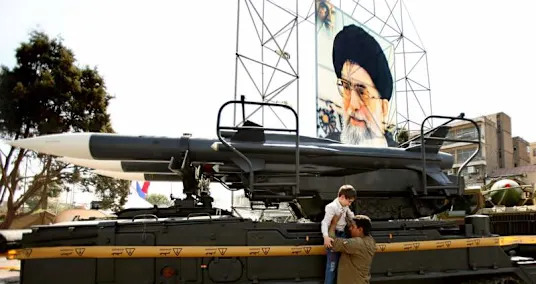
The Islamic regime’s revolutionary guards has stepped up campaigns to recruit children as young as 12 to join the military, Rahim Nadali, the cultural and artistic deputy of the IRGC’s Mohammad Rasoulollah Corps, told Iran’s Defa Press Agency last week.
“We launched a plan we call ‘For Iran’, which is a registration program for homeland defense fighters,” Nadali told state media. “We set the minimum age at 12 years and above.”
The recruitment drive aims to see civilians support the regime with cooking services and medical care, distributing items, and deal with damaged homes, as well as for security activities such as staffing checkpoints, operational patrols, intelligence patrols, and vehicle convoys.
Nadali said that “[in relation to] intelligence and operational patrols, teenagers and the youth repeatedly have come and said that they want to take part in them. For the Basij checkpoints that you see across cities now, we have had many young people and teenagers demanding to be present in them. Given the ages that were making demands, we have set the [minimum] age at 12. Meaning now there are kids of 12 and 13 who want to be present in this space.”

Human rights groups have warned that recruiting minors under the age of 15 constitutes a war crime and is a grave violation of children’s rights.
Children can register at mosques with Basij bases.
Human Rights Watch condemns Iran's military recruitment of children
“There is no excuse for a military recruitment drive that targets children to sign up, much less 12-year-olds,” said Bill Van Esveld, associate children’s rights director at Human Rights Watch. “What this boils down to is that Iranian authorities are apparently willing to risk children’s lives for some extra manpower.”
Only days after Nadali’s announcement, 11-year-old Alireza Jafari was reportedly killed at a military checkpoint, according to state media. The Basij Teachers Organization confirmed the minor was killed “on duty.”
Jafari’s mother told the Hamshahri newspaper a “personnel shortage” led her husband to take their son to work with him.
“The officials involved in this reprehensible policy are putting children at risk of serious and irreversible harm and themselves at risk of criminal liability,” Van Esveld said. “Senior leaders who fail to put a stop to this can make no claim to care for Iran’s children.”
This is not the first time the Islamic regime has relied on child soldiers to fill personnel gaps. During the Iran-Iraq war, the regime allowed children as young as nine to clear minefields, compensating impoverished families when the children were killed fulfilling their duties.
Former child recruit describes devastating psychological impact
Afshin Javid, a former child recruit for the Basij paramilitary force who was recruited at age 12 to help with morality policing, and later went on to clear minefields before joining the executions team, told The Jerusalem Post that the psychological impact on children was devastating.
“When a Muslim becomes a true follower of Allah, then you have to go to war. You become a soldier of Allah, to go to war with the hope of being a martyr. So the destination is not the destruction or the conversion of the infidel, but the hope is actually more based on the reward that comes, hoping you die,” he explained. “From childhood, it's taught, ‘Hey, kill the infidels.’ In this case, ‘kill the Jews.’ So that idea is rooted in their belief, and then out of that comes the teaching of Islam that is in every family. This is not only child marriages, but the belief in child soldiers. So this is the very womb that creates an environment for all of child soldiers to be recruited.”
"Everything from the family unit, the media and the schooling system teaches children that dying for Allah is a 'privilege,' preventing children from seeing a future as a lawyer or a doctor or dreaming of any career path or family life that could be emotionally and physically rewarding,” he explained.
“Imagine giving a child the power of holding a gun and saying that you are able to take the life of an infidel and you're going to get rewarded,” he concluded, noting that it was a difficult mentality for many to understand.
LATEST POSTS
- 1
 Treason trial of South Sudan's suspended VP is further eroding peace deal, UN experts say
 - 2Artemis 2 astronauts are about to see one of the rarest skywatching sights of all — a solar eclipse from beyond the moon
- 3Iran-backed Iraqi militias attack Kurdistan over 450 times since beginning of war
- 4Eco-Accommodating Kitchen Machines: 4 Picks for a Manageable Home
- 5Yemen's Houthis ready to join Iran war if needed, raising new shipping risk



- Old video misrepresented as senior Sri Lankan ruling party member criticising president over fuel shortage
- State asks High Court to reject challenge to anti-UNRWA laws ahead of Monday hearing
- Gartex Texprocess India to showcase innovations across textile ecosystem
- China's 'Venice Of The East' Is A Historic Canal City Near Shanghai With Arched Bridges And Lantern-Lit Waterways
- The 15 Most Compelling Books in History
- German hauliers warn soaring energy prices may soon impact consumers
- Six Flags Opens the Tallest, Fastest and Longest Roller Coaster in the World
- King Charles III says he is reducing cancer treatment schedule in 2026
- 2026 will be the year NASA astronauts fly around the moon again — if all goes to plan