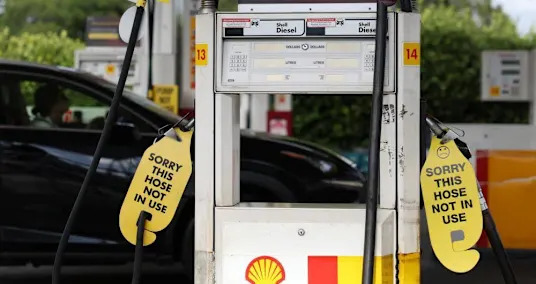
The Australian government has encouraged people to go ahead with their Easter travel plans, despite fuel shortages at hundreds of petrol stations across the country.
"Easter is a very special time of faith and family," energy minister Chris Bowen said on Saturday, adding: "Go take a break - but get no more fuel than you need".
Fuel prices in Australia have soared since the start of the US-Israel war with Iran and the effective closure of the Strait of Hormuz, a key route for global oil and gas shipments.
Bowen said 312 of Australia's roughly 8,000 service stations had run out of diesel, mostly in rural areas where it takes longer to replenish stocks.
In televised remarks, he said the nation had 39 days worth of petrol, 29 days worth of diesel and 30 days worth of jet fuel in reserve.
Australia imports about 90% of its fuel from the Middle East and has been particularly exposed to the disruption caused by the conflict and Tehran's blockade of the Strait of Hormuz.
The near-total suspension of international shipping in the vital waterway - through which around 20% of the world's oil and natural gas flows - has prompted governments around the world to implement measures to conserve fuel.
In a rare televised address to the nation on Wednesday, Prime Minister Anthony Albanese warned that the economic shock from the Middle East conflict would be felt for months.
"Australia is not an active participant in this war. But all Australians are paying higher prices because of it," he said.
He encouraged Australians to limit unnecessary fuel use and switch to public transport where possible.
A small number of vessels have passed through the Strait of Hormuz in recent days.
On Friday, a Malta-flagged container ship owned by French company CMA CGM traversed the waterway, according to French media reports.
It is unclear how the vessel secured safe passage and the ship's owners have not yet commented.
Shipping analysts said it was the first vessel owned by a major Western European firm to go through the strait since the conflict began on 28 February.
While Iran has said "non-hostile vessels" can use the waterway, the ongoing conflict - in which several ships have been attacked - has halted normal transport activity.
A Japanese vessel carrying natural gas also successfully crossed the waterway, its operator confirmed.
On Saturday, Turkey's transport minister said that a second Turkish-flagged vessel had crossed the strait - one of 15 that had been waiting to transit since hostilities erupted.
The first crossed, with Iranian permission, on 13 March.
"Two of these 15 made the crossing," Abdulkadir Uraloglu told CNN's Turk channel. "This is explained by our initiatives and also by the fact that they were using Iranian ports or carrying goods coming from or bound for Iran."
About a fifth of the world's oil and liquid natural gas is transported through the Strait of Hormuz from the Gulf countries.
While traffic is down about 95% compared to before the conflict, shipping through the narrow waterway has not stopped altogether.
About 100 vessels have been able to pass through the strait, according to data analysed by BBC Verify in late March.
LATEST POSTS
- 1
 Belarusian parliament passes a bill to crack down on LGBTQ+ rights
 - 2Qatar, Ireland accuse Israel of using chemical weapons on Palestinians, demand watchdog probe use
- 3The many ways that baking is winter therapy. With a delicious ending
- 4'Dancing With the Stars' Season 34 finale: Who might win the mirror ball trophy? Where do the remaining contestants rank?
- 5Astronaut on ISS captures spectacular orbital video of zodiacal light, auroras and the Pleiades



- Three arrested in Paris after attempted bomb attack outside Bank of America
- Lebanese Shi’a party Amal competing, coordinating with Hezbollah, experts tell ‘Post’
- Chinese astronauts’ return to Earth delayed over fears spaceship damaged by debris
- Taste the World: Five Food sources That Have Dazzled Worldwide Palates
- Figure out How to Streamline Eco-friendliness in Your Volvo XC40
- Creativity Revealed: A Survey of \Making Shocking Looks\ Cosmetics Item
- From record warming to rusting rivers, 2025 Arctic Report Card shows a region transforming faster than expected
- Europe's powerful Ariane 6 rocket launches Sentinel-1D Earth-observation satellite to orbit (video)
- Gilead's new HIV prevention shot added to CVS's drug coverage lists, CEO says